Key developments
- 🇩🇪 In January 1985, the Constitution of the German Federal State of Saarland is amended to include a recognition of the right to data protection (Art. 2: ‘Jeder hat Anspruch auf Schutz seiner personenbezogenen Daten. Eingriffe sind nur in überwiegendem Interesse der Allgemeinheit auf Grund eines Gesetzes zulässig’).
Also this year
- On 11 April 1985, OECD Ministers adopt the Declaration on Transborder Data Flows.
- On 8 October 1995, the European Parliament adopts a Resolution on the consequences of the new technologies for European society notably stating that ‘despite grand statements of intent, insufficient attention is devoted to the protection of the private individual in data transmission and recording systems’, and requesting ‘the Commission to study the problem of data protection at European level and to consider the approximation of legislation in this area, since several Member States have already taken steps in this direction’.
- The Transnational Data Reporting Service, Inc., organises a 3-day Conference on ‘The International Information Economy, Agenda for Action’.
- 🇪🇺 At the European Commission:
- Gillespie, Andrew et al. (1985), The effects of new information technology on the less-favoured regions of the Community, Studies: Regional Policy Series 23 (cf. p. 30).
- The 7th International Conference of Data Protection and Privacy Commissioners takes place in Luxembourg.
Literature

- Bing, Jon (1985), Data Protection in Practice: International Service Bureaux and Transnational Data flows, Complex 1/85.
- Denninger, Erhard (1985), ‘Das Recht auf informationelle Selbstbestimmung und Innere Sicherheit: Folgerungen aus dem Volkszählungsgesetzurteil des Bundesverfassungsgerichts‘, Kritische Justiz 18(3), 215–244.
- Gassmann, Hans-Peter (1985), ‘Vers un cadre juridique international pour l’informatique et autres techniques nouvelles de l’information‘, Annuaire Français de Droit International, 31, 747-761.
- Gassmann, Hans-Peter (1985), ‘The influence of George Orwell’s “1984” on privacy protection legislation‘, Computer Networks and ISDN Systems 9, 1, 29-31.
- Mellors, Colin and David Pollitt (1985), ‘The slow emergence of data protection in Britain‘, Consortium for Political Research on ‘Confidentiality, Privacy and. Data Protection’, Barcelona, 25 – 30 March 1985.
- Millard, Christopher J. (1985), Legal protection of computer programs and data, Sweet & Maxwell.
- Smith, Robert Ellis (1985), Report on data protection and privacy in seven selected states by Robert Ellis Smith for the Office of Technology Assessment.
- Solomon, Toby (1985), ‘Personal Privacy and the 1984 Syndrome‘, Western New England Law Review, 7(7), 753-790.
- Wilson, Laurie J., and Ibrahim Al-Muhanna (1985), ‘The political economy of information: The impact of transborder data flows‘, Journal of Peace Research 22(4), 289-301.
Films

- 🎬 Brazil (1985), Terry Gilliam.
In the media
- Tucker, Elizabeth Tucker, ‘Telecommunications Firms Face Barriers‘, The Washington Post, 20 January 1985.
- ‘Data protection — the new computer game‘, Press, 8 October 1985, 27.
In memoriam
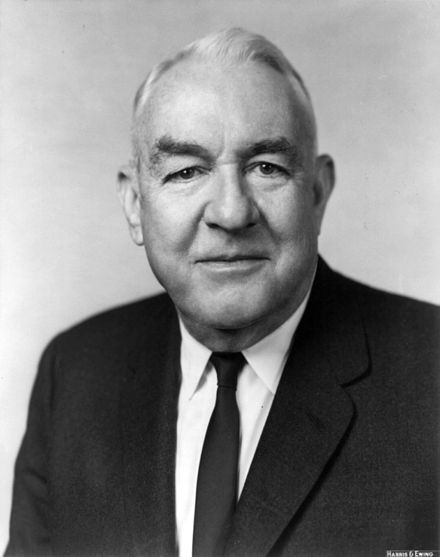
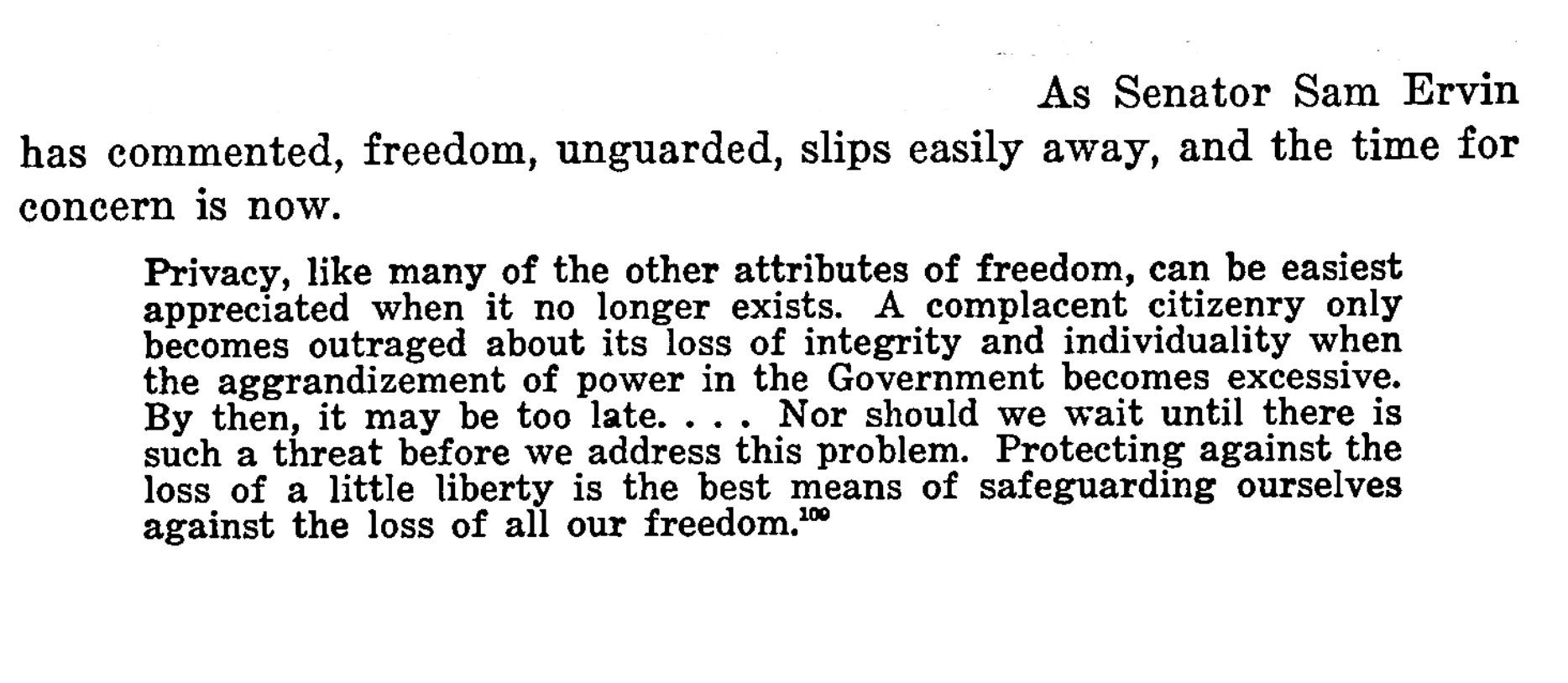
- Sam Ervin Jr. (27 September 1896 – 23 April 1985): US politician who played a key role in the defence of privacy as a Senator in the 1960s and 1970s. During a speech in 1967, he stated: ‘On the basis of my own study, I came to the conclusion that ewe have nothing to fear from the computer as a machine. Alone, its use does not threaten individual privacy. The threat to privacy comes from men – from the motives of political executives, from the ingenuity of managers, and the carelessness of technicians‘ (8 March 1967, Congressional Record, Senate, 5898-5901).
 Gloria González Fuster