Key developments
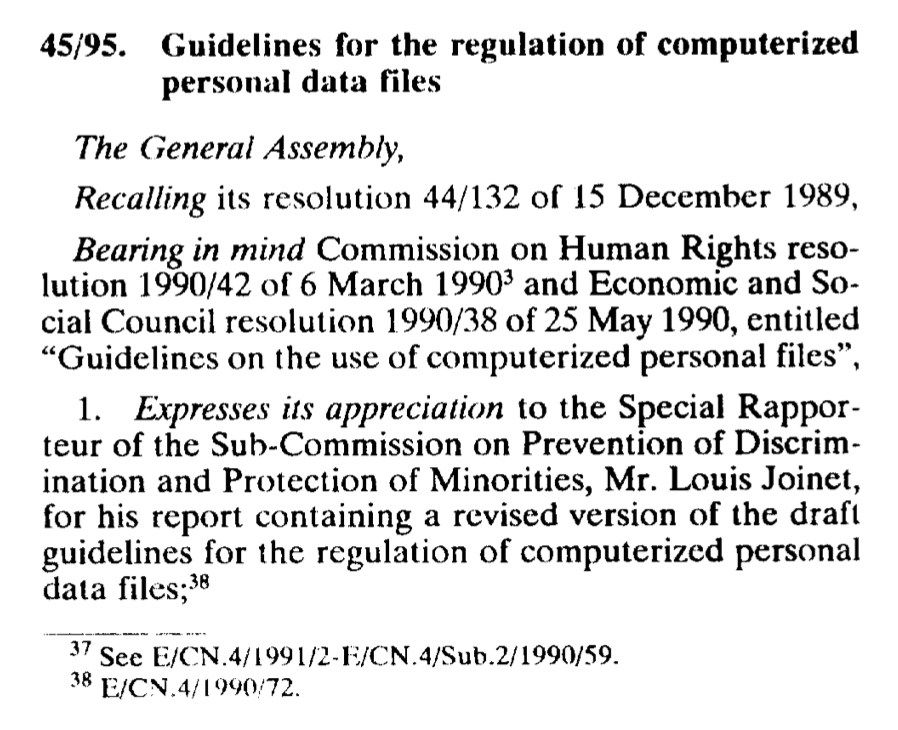
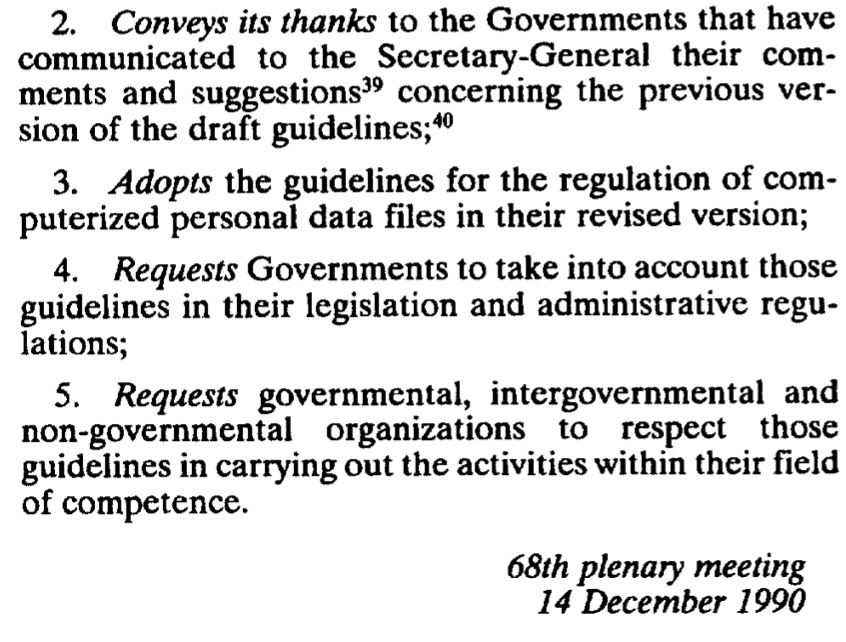
- 🇺🇳 On 14 December 1990 the General Assembly of the United Nations (UN) adopts its Guidelines for the Regulation of Computerized Personal Data Files (Resolution 45/95).
- 🇪🇺 The European Commission publishes its first ever legislative package on data protection, a document of 13 September 1990, featuring notably:
- Commission Communication on the Protection of Individuals in Relation to the Processing of Personal Data in the Community and Information Security;
- Proposal for a Council Directive concerning the protection of individuals in relation to the processing of personal data;
- Commission Declaration on the application to the Institutions and other bodies of the European Communities of the principles contained in the Council Directive concerning the protection of individuals in relation to the processing of personal data;
- Proposal for a Council Directive concerning the protection of personal data and privacy in the context of public digital telecommunications networks, in particular the integrated services digital network (ISDN) and public digital mobile networks;
- Recommendation for a Council Decision on the opening of negotiations with a view to the accession of the European Communities to the Council of Europe Convention for the protection of individuals with regard to the automatic processing of personal data;
- Proposal for a Council Decision in the field of information security.
Also this year
- The Schengen Convention, supplementing the 1985 Schengen agreement and laying down the arrangements and safeguards for establishing an area without internal border controls, is signed on 19 June 1990 by Belgium, Germany, France, Luxembourg and the Netherlands. It foresees data protection rules, and it will enter into force in 1995.
- ⚖️ The European Court of Human Rights (ECtHR) decides in Kruslin v France, on 24 April 1990.
- 🇩🇪 In Germany, in September 1990, the Constitution of the Federal State of Berlin is amended to include a reference to the right fundamentally determine the disclosure and use of personal data (Art. 21b: ‘Das Recht des einzelnen, grundsätzlich selbst über die Preisgabe und Verwendung seiner persönlichen Daten zu bestimmen, wird gewährleistet. Einschränkungen dieses Rechts, bedürfen eines Gesetzes. Sie sind nur im überwiegenden Allgemeininteresse zulässig’).
- 🇭🇷 The Croatian Parliament promulgated the Constitution of the Republic of Croatia, which devotes its Art. 37 to personal data protection & establishes that without consent from the individual personal data may be processed only under conditions specified by law.
- 🇺🇸 ‘Data protection, computers, and changing information practices‘, Hearing before the Government Information, Justice, and Agriculture Subcommittee of the Committee on Government Operations, House of Representatives, 16 May 1990.
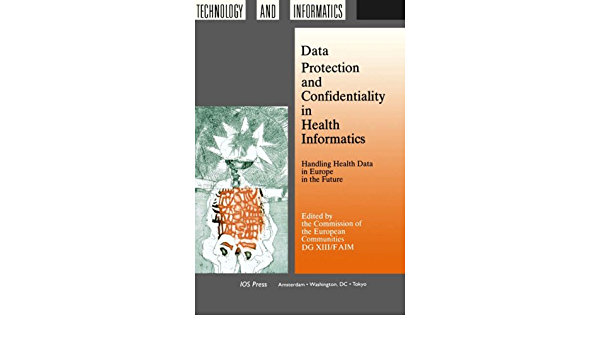
- On 19 and 20 March 1990 takes place in Brussels a Working Conference on ‘Data protection & confidentiality in health informatics: Handling health data in Europe in the future’, organised by the European Commission in the context of the Advanced Informatics in Medicine (AIM) programme.
- The 12th International Conference of Privacy and Data Protection Commissioners takes place in Paris.
Literature
- Allen, Anita L., and Erin Mack (1990), ‘How Privacy Got Its Gender‘, Northern Illionis University Law Review 10(3), 441-478.
- Bing, Jon (1990) ‘Three Generations of Computerized Systems for Public Administration and Some Implications for Legal Decision-Making‘, Ratio Juris 3(2), 219-236.
- Laperrière, René et al. (1990), Crossing the borders of privacy: Transborder flows of personal data from Canada, A study undertaken by the Computer Science and Law Research Group, commissioned by the Government of Canada.
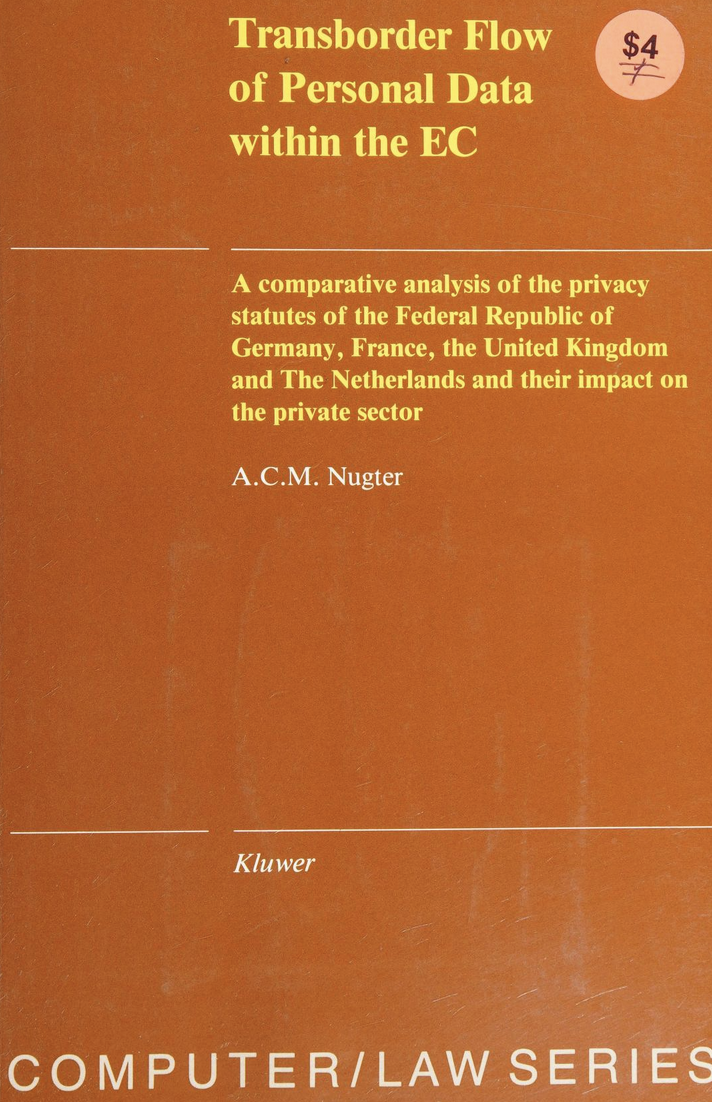
- Nugter, Adriana C. M. (1990), Transborder flow of personal data within the EC : A comparative analysis of the privacy statutes of the Federal Republic of Germany, France, the United Kingdom, and The Netherlands and their impact on the private sector, Kluwer.
- Rigaux, François (1990), La protection de la vie privée et des autres biens de la personnalité, Bruylant.
- Robinson, Peter. (1990), ‘TDF issues: Hard choices for governments‘, Telecommunications Policy 14(1), 64-70.
In the media
- Rule, James B., ‘For whose eyes only?’, The New York Times, March 4, 1990
 Gloria González Fuster